What are the required permits for the Manaslu Trek?
Unlike in the open Everest, Annapurna, and Langtang trekking regions of Nepal, during the Manaslu Trek, you can not simply show up, purchase a solo permit, and head to the trailhead. Similar to the Upper Mustang Trek, Upper Dolpo Trek, and the Kanchenjunga Base Camp Trek, whether you choose the cultural trek route such as the Tsum Valley and Nar Phu or the classic circuit trek, you will have to obtain at least 3 permits beforehand for journeying in Manaslu.
Despite opening of the region in 1992 for tourists and tourism, it is still one of the most highly restricted areas of the country, designated so due to its proximity to the Tibet border and to conserve the region’s unique culture and fragile Himalayan ecosystem, and hence trekking, climbing, or any other adventurous activities operate a bit differently, and the Manaslu Circuit trek permits, guide, and application process we have tried to simplify here:
The Restricted Area Permit (RAP)
The government of Nepal has designated the areas between Jagat and Dharapani as a restricted zone of the Manaslu region. Beginning from Jagat, the restricted zone continues to charming villages like Sama Gaun, Samdo, and Bhimtang until exiting Dharapani, which are also some of the major stopping points during the trekking to the Manaslu Circuit under the Tsumnubri Rural Municipality of wards no. 1 to 4.
Hence, you will need a RAP permit, which is checked at the official entry point, Jagat, and at the last checkpoint, Dharapani. Every year, only limited permits are issued to control the tourism flow and preserve its heritage and biodiversity, and it is only through a licensed trekking agency or a local guide under one of them, such as the Himalayas On Foot. New update on March 2026: you may not need a group, but a guide and permits are still mandatory.
The Manaslu Conservation Area Permit (MACP)
The Manaslu Circuit Trekking Trail is part of the larger Manaslu Conservation Area. Spread over an area of 1,663 square kilometers, established in 1998, it is home to a wide range of flora and fauna, especially when the area comprises mountains, glaciers, and watercourses ranging from 1,400 m to 8,156 m at the Manaslu Summit point. Likewise, this region is also inhabited by various ethnic communities of Nepal.
To contribute to the region’s conservation efforts within the area and also support the livelihood of the locals is what you pay the Manaslu Conservation Area Permit (MCAP) fee for. The prices generated from issuing the MCAP permit help with sustainable development and register the trekkers. In case of need and emergencies, authorities' facilities require aid as per it, and obtaining the MCAP is one of the major permits for trekking to the Manaslu Circuit.
The Annapurna Conservation Area Permit (ACAP)
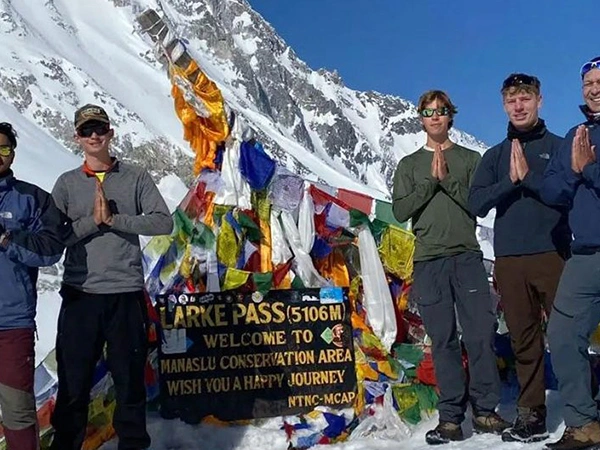
Although the main trekking route of the Manaslu Trek doesn’t pass through the Annapurna Conservation Area, the largest conservation area of Nepal, based on the specific chosen trail, you often do enter the Annapurna region after crossing the Larkya (Larke) La Pass. Almost at the end, the trek connects you to the Annapurna trekking and climbing zone at Dharapani, and hence the Annapurna Conservation Area Permit is required during this section of the trek.
Similar purposes and fees to the MCAP. It is not affected by the time of the year you are journeying into nor the trekker’s group size. Even if you trek during the peak seasons (spring and autumn) or off-seasons (winter and summer), the fee is the same. Likewise, it has unlimited validity applicable for a one-time trek, i.e., with this permit you may continue to complete short- to long-term Annapurna treks from Ghorepani Poon Hill to Annapurna Circuit.
When do you need a Trekkers’ Information Management (TIMS) card?
Taken as the standard permit for trekking and climbing in Nepal, the Trekkers Information System (TIMS) card is intended to provide security and safety to trekkers. It records the details of each trekker visiting the country for Himalayan adventures. Which however, for the Manaslu Circuit Trekking alone is not required. The Restricted Area Permit system already tracks the trekkers entering the Manaslu region.
I.e., the RAP and MCAP fulfill the necessary registration and monitoring requirements unless and until you are planning to do the combined Manaslu Circuit with the Annapurna Circuit Trek or other trips into the Annapurna Himalayas, such as the Mardi Himal Trek, Khopra Danda Trek, or the Mohare Danda Trek. Otherwise, for trekking inside the Manaslu region only, no, you won’t need the TIMS card, which in general costs NPR 2,000 payable in Nepalese rupees only.
Manaslu Circuit Trek Permits guide and application process
The update by Nepal’s Department of Immigration on restricted area trekking rules in March 2026 has removed a minimum group requirement of at least two foreigners. Yes, now solo trekkers can also get the restricted area permit (RAP), but it is still a must that you obtain other required permits and are on a guided trip, including for the trek to Manaslu Circuit. It must be obtained through a registered trekking agency. Here are the complete the following procedures:
- Choose a licensed local operator such as Foot on the Himalayas. Awarded by the Travelers’ Choice in 2023, 2024, and 2025 with a 5/5 rating with 242 reviews.
- Select the suitable trek itinerary for the Manaslu Circuit, including arrival and departure dates.
- Submit a copy of the passport with at least six months of its validity. The information from here will be used to complete the permit form.
- Provide your Nepal visa (on arrival, a tourist visa is available at the entry point of the Tribhuvan International Airport (TIA)), a copy, and a few passport-sized photographs.
- Verification of official documents like the updated guide insurance, tax clearance, etc.
- Pay the required permit fee (payable in both US dollars and local currency) and collect the deposit voucher or purchase one of the comprehensive Manaslu Circuit Trek packages from the trekking agency; they will obtain it for you, including the arrangement of a guide.
Where can you get a Manaslu Circuit Trek Permit?
In recent years, the MCAP and ACAP alone have been available online. If you are already in Nepal, you can obtain these Manaslu Circuit trekking permits in either Kathmandu or Pokhara. But the trekking itinerary may not always follow the Pokhara route, so it is better to get these permits while in Kathmandu, which the Nepal Tourism Board office at Pradarsani Marg issues. No, these cannot be obtained at check posts along the trekking routes, except at Besisahar.
At the respective counter of Besisahar, open from Sunday to Saturday from 9 A.M. to 5 P.M. and closed on public holidays, you can get the ACAP. As per the RAP and TIMS card, it must be processed through government-registered trekking agencies such as Himalayas On Foot. With us, the process will be quick and easy. We arrange documents and pay the permit fee in local currency, all included in the package price. The easy Manaslu Circuit Trek permits it for you.
What is the Manaslu Trekking Permit Cost?
The Manaslu Circuit Trek permit fee of the MCAP, ACAP, and TIMS card, unlike that of the RAP, once set, remains constant throughout the year. Whether in the peak trekking seasons of March to May (spring) and September to November (autumn) or the times of the year taken as off-seasons for high-altitude treks and climbs, summer and winter, there is no change in the fee even when using the permits for longer days; it's valid during an entire trip.
The restricted area permit cost for the Manaslu Circuit trek is comparatively higher in the autumn season than at other times of the year, as it is a peak trekking season. However, the rest of the seasons are less favored, as it is a low time for the Manaslu Trek. Therefore, there are low charges on the permits issued during the shoulder season and off-season, so if you wish to cut the permit costs and avoid crowds, make bookings now.
The cost of the Manaslu Conservation Area Permit (MCAP)
The Manaslu Conservation Area Permit (MCAP) fee in general for all foreign nationals is NPR 3,000 (USD 30) per person, while those for SAARC nationals (Afghanistan, Bhutan, Bangladesh, Maldives, Nepal, Sri Lanka, and Pakistan, including India) are NPR 1,000 per person. However, it is free for children under 10 years, and for Nepali citizens, it is only NPR 100 per person with no time validity and cost differences depending on the season.
The Restricted Area Permit (RAP) Fee
The exact price of this Manaslu Circuit trek permit cost does vary significantly based on the trekking seasons and number of trekking days. The costs from September to November in the autumn season are US $100 for the first week, and after seven days, US $15 is charged per person for each extra day. Similarly, from December to August, three seasons, it is US $75 for only 7 days, and from the 8th day, US $10 per person for each additional day spent is added.
Annapurna Conservation Area Permit (ACAP) Cost
A round trip to the Manaslu Circuit often includes descending through the Annapurna region, across Besisahar from Dharapani, which further falls into the Annapurna Conservation Area, making it essential that you get the ACAP permit, highly dependent upon the route that you chose. Where the cost is the same as the Manaslu Conservation Area permit (MCAP). NPR 3,000 for foreign nationals and NPR 1,000 for SAARC national trekkers.
The Trekkers Information Management System (TIMS) Card Cost
Needed only when you are thinking of doing the Manaslu Trek along with the Annapurna Circuit or other Annapurna treks and continuing the journey to other high Himalayan trekking regions, the cost of a TIMS card for SAARC (South Asian countries) citizens is NPR 1,000 per person; that implies the Manaslu Circuit Trek permit cost for Indians as well. While the general cost of the TIMS card is NPR 2,000 for trekkers beyond these countries.
Conclusion
Understanding the system of trekking permits for the Manaslu Circuit is a mandatory baseline. Especially when the region is one of Nepal's restricted areas, where tourism is controlled with regard to border sensitivity, unique culture, and sensitive Himalayan ecosystems. Himalayas On Foot believes in leaving every trail better than before and hence strongly advises that you respect the nation's initiative for conservation.
We understand it can feel hassling to manage all by yourself. Established in the year 2006 at the heart of the Himalayan country of Nepal, Kathmandu, it is where Himalayas On Foot stands at the top for seamless logistics and guidance to essential permit management, including for the years 2026 and 2027. Fixed group departures are in spring and autumn, or plan solo, family, or private trips with our customizable itinerary. Contact us; we are here for you 24/7.